
Wendell Minor
Wendell Minor is a man who knows how to make things happen. Burdened academically as a child by dyslexia, he sought—and found—success in the alternate universe of art.
There, having achieved renown as an illustrator and book cover designer, he actively collaborated with authors he came to know to develop his own ideas for books covering a wide range of topics.
Along the way the Washington CT resident garnered honors such as the Cook Prize; Bank Street College of Education’s Best Children’s Books of the Year; Publishers Weekly Best Books of the Year; Kirkus Best Books of the Year; New York Public Library’s 100 Best Books for Kids; Junior Library Guild Gold Selections; Pennsylvania One Book Every Young Child selection and many more.
Minor was the 2018-2019 Artist Laureate of the Norman Rockwell Museum, served on the board of the Norman Rockwell Museum and received an Honorary Doctorate from the University of Connecticut.
He began his career as a book cover designer, creating more than 2,000 much-admired book covers over the course of his career for noted authors such as David McCullough, Pat Conroy, Fannie Flag and Nathaniel Philbrick. His cover art for McCullough’s book, Truman, achieved the distinction of being in the permanent collection of the Smithsonian's National Portrait Gallery in Washington DC.
He later became the author or co-author of more than 60 award-winning books of his own.
“You have to make things happen,” he said succinctly this week as he looked back on his long career.
Now 81, he is still making things happen but for the moment he is letting ideas gestate. “I have decided to paint for myself until I find a book project I like,” he said. “I have a few ideas in the back of my head but right now it is so liberating to just paint what I want.”
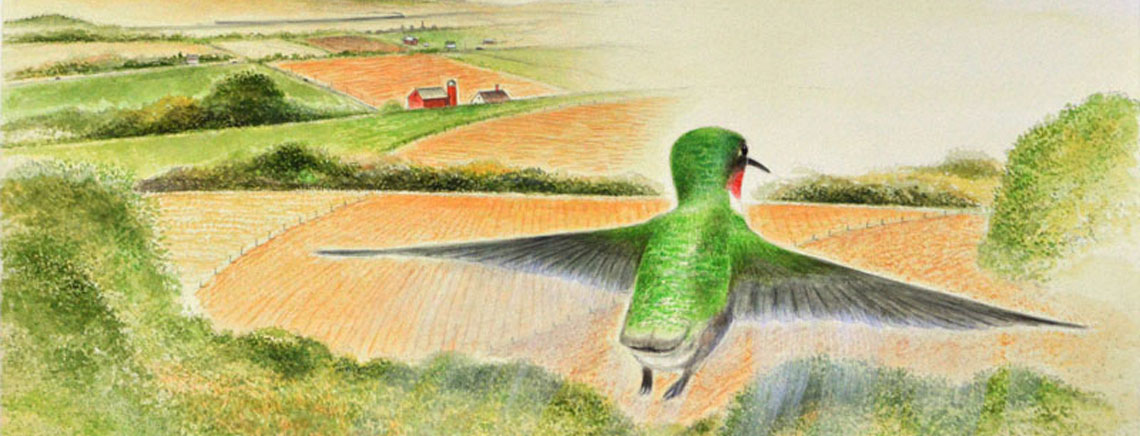
He is also currently exhibiting 25 of his works in a show, “Wendell Minor: American Stories,” that opened last weekend at the Cornwall Library. The exhibition is curated by Stephanie Plunkett, chief curator at the Norman Rockwell Museum, of which Minor is a Trustee Emeritus. The Cornwall exhibition of book jackets, original watercolor paintings and related drawings continues through January 11th. It features a selection of Minor’s original watercolor paintings for children’s books, including Pumpkin Heads; Cat, What Is That?; Buzz Aldrin: Reaching for the Moon; Everglades and The Last Train.
“These are works that span Wendell’s career,” Plunkett said. “They are focused on two aspects: his illustrative book jackets and children’s books. In my mind, Wendell brings the same esthetics to fine art and to his work as an illustrator. Sometimes his work is a little more impressionistic; sometimes more realistic but he has a fine eye for detail and mood.”
A Midwesterner, Minor grew up on an Aurora IL farm, living his life among pragmatic Norwegian farmers. Neither parent was an artist but his mother quietly encouraged her son to pursue his passion. He got additional support from his teachers who recognized his talent from the beginning.
“By the time I was in fourth grade, I had decided to be an artist,” he said. His talent was nurtured throughout his school years. “I had wonderful art teachers all the way through school,” he said. “I spent more time in art classes than anything else.”
And he found inspiration from the illustrations he saw in periodicals of the day. “As young boy, I delivered papers,” he recalled. “There was a drug store on my route that sold the Saturday Evening Post and I was inspired by Norman Rockwell’s work and that of other illustrators.”
One of Rockwell’s illustrations, “Breaking Home Ties,” tells the visual story of a farmer father, battered hat clutched in his hands, who is sitting next to his nattily attired son, both waiting for the train that will carry the boy off to college. “That painting encouraged me to think that I could go away, too,” he said.
Determined to forge a career as an artist, he sold his 1955 Chevy to pursue his studies at the Ringling School of Art and Design in Florida. “After school, I went to work for Hallmark Cards in their Kansas City book division,” he recounted. “I often put in 80-hour weeks—to survive, that’s what you had to do.”
Then, he pulled up stakes and moved to New York in 1968, where he worked for the legendary book jacket designer Paul Bacon who created the original cover for William Styron’s novel, Sophie’s Choice.
“He was very generous in encouraging me to go independent so, at age 26, I opened my own studio in New York. If you can make it there, you can make it anywhere,” he quipped. “I had to try my best to succeed and I found I could.”
He and his late wife, Florence, remained in the city for 23 years. She worked as a documentary film editor for ABC News “and we both worked ridiculous hours,” he related. Eventually, the lifestyle grew thin and they began to think about relocation and a new career for her.
“I was the president of the Society of Illustrators and that kept us anchored there until my term ended,” he said. But on a visit to Litchfield County to see friends, they saw a little house and fell in love with it.
She entered a second career in the publishing world, often collaborating with her husband who illustrated her works. Their If You Were a Penguin was chosen by Pennsylvania for its "One Book, Every Young Child" early literacy program. She also co-edited a 25-year retrospective of Minor's book cover art, Wendell Minor: Art for the Written Word.
Despite his early struggles with literacy, Minor has a profound respect for the written word. “Because I am so visual, I speak in pictures but I have authored my own books and there is a close connection,” he said. “(When I design a book cover,) I try to read the book and absorb the story. The style I use vacillates from here to there but good drawing and good painting is what I am a stickler for.”
He also likes to talk to authors before he develops his ideas. “I’ve worked with scores of authors and I got to know a lot of them. I always wanted to talk to them, to know where they were coming from and I never wanted to do a book cover that disappointed the author.”
Pulitzer Prize-winner David McCullough was among his satisfied clients. Minor first met McCullough in 1972 and they formed a lasting bond. Minor created the covers for almost all of McCullough’s books but it was his work on the cover of Truman that he credits with making a lasting change in his career.
“David McCullough came and talked with me about his book, Truman. I became very impressed with him and we became close friends,” he said. Minor said he drew on the style of Thomas Hart Benton, an American painter, muralist and printmaker from President Truman’s home state of Missouri, in creating the cover for the book. He devoted 48 hours over the course of four days to the cover painting which was requested by McCullough himself.
“I have had the good fortune to work with Wendell Minor in the planning stages for covers of a number of my books, going back more than thirty years,” McCullough wrote, “and I know how brilliant he is at getting to the essence of a subject. Look, for example, at how much of the background and life-journey of Harry Truman is to be seen in his cover for Truman, and how fittingly the tilt of the profile suggests the essential straightforwardness and courage of the man.”
“Each cover assignment took me on a journey of discovery that required research and careful consideration of the text to create the visual essence of the book,” Minor noted. “A good picture, like a good story, is timeless.”
The Cornwall Library is located at 30 Pine Street. It is open Tuesday, 10AM to 5PM; Wednesday, noon to 7PM, Thursday and Friday, noon to 6PM, Saturday, 10AM to 2PM; and Sunday, noon to 3PM.